Yarden Dachut: London Designer Blending Napoleonic Military Tailoring, Leather Craft, and Gothic Fantasy Fashion
Artisanal leather jackets, Napoleonic references, and militaristic tailoring are key staples of
fashion designer Yarden Dachut’s work.
Yarden is a London-based independent designer whose practice is as much about building a world and narrative as it is about the clothes themselves.
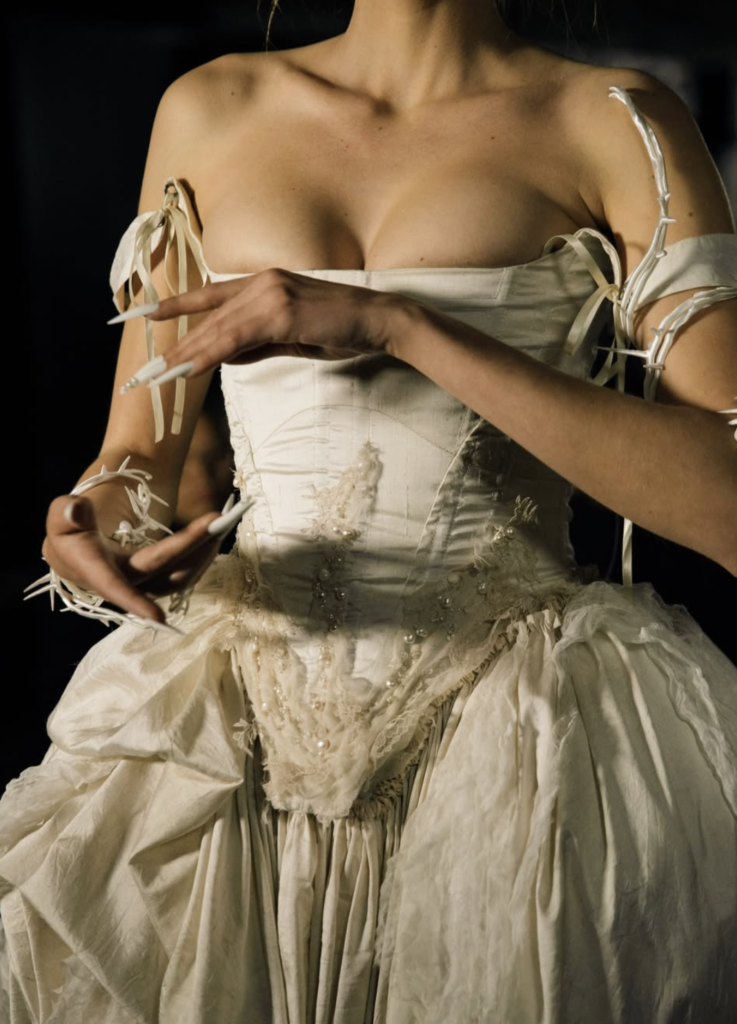
His work references visual kei and dark gothic fashion, alongside 19th-century dress, balancing an archival sensibility with something more otherworldly, recalling the theatrical codes of designers like John Galliano, Alexander McQueen, and Yohji Yamamoto.
His jackets are defined by signature recurring elements: details such as Regency-style collars, hidden pockets, epaulettes, armbands, and double zips. Fusing sharp tailoring with avant-garde silhouettes, Yarden transforms sartorial codes of authority and protection into spectacle, opening up space for indulgence and reinvention.
Each garment is meticulously handmade by Yarden, with an attention to detail that carries
through from fabric sourcing to the final tailoring touches.
His approach to design remains deeply personal. “The design always comes from me,” he says, noting that while many pieces are later tailored or remade as bespoke orders, “the majority of the time it’s just something I wanna make.”
That instinct-driven process feeds into a continual cycle of creation and release: he rarely keeps his own work, with each piece sold to fund the next – “like the circle of life.” When we speak, our conversation turns to instinct, experimentation, and the worlds he builds through clothing.
Where do your influences typically come from? Do you design from historical reference, a concept or feeling?
Definitely anime, historical paintings and garments, and video games. Usually, my garments
begin with a central idea, often rooted in a historical reference or a certain time period. More often than not, the concept just comes to me when I’m sketching.
Why did you want to become a designer?
I never thought I was going to become a designer. I actually thought I was going to be an English or psychology major, but during Covid I watched a lot of anime, and wished I could wear that kind of clothing, so it kind of stemmed from there.
What does your design process look like?
My design process always starts with a mental image. I view a lot of my designs as refining a blade rather than crafting a new sword, so a lot of my designs build off each other and lead in different directions from the textile and pattern. I’m traditionally taught in pattern making and tailoring, so it’s more of a mental image rather than a perfect sketch, and the magic really happens when I construct and make on-the-spot decisions.
I like the idea of creating a universe that makes sense within the timeline – like building a
branch on a tree that all leads to one stem rather than making a bunch of different trees each time.
What is your favourite garment from your collection and why?
I never really have a favourite garment, but something in my collection that really excites me is this new hat I made called the Passer Hat, which means sparrow in Latin. I don’t think it’s my best piece by any means, but it’s just fun to try something new, so that’s got to be my favourite right now.
What do you want your clothes to express?
I want my clothes to express a blend of historical accuracy with a twist of fantasy that can be loud if you dress it up or casual if you dress it down. I want to make clothes that feel like a second skin or a shroud, and just something to enjoy, to be honest.
Your work feels materially and emotionally deliberate. What draws you to working with
leather, and how does its permanence shape your design process?
My favourite thing about working with leather is that every piece is different, which makes me more cautious than when I work with regular fabrics. If you sew through leather, it leaves a permanent hole, unlike denim or other fabrics, where you can just take out the seam, so it forces me to be much more mindful and pushes the design to be its best so that nothing gets wasted.
How do you embrace reinterpretation, or is there a specific way you believe the garments
should exist?
I think reinterpretation is one of the most important things in history. Without it, some of the
best pieces of art and music wouldn’t exist, so as long as you’re trying to be original and make your own version with it, I’m so here for it.
Is there a specific person or idea of a person that you’re designing for?
I used to think I was designing for people like me, but the more I make clothes, the more I’ve
realised that the majority of the people buying my work are the complete opposite of me. So I’ve stopped thinking about who I’m designing for, and instead I am trying to focus more on what actually makes me happy.
What are you working on next?
Recently, I’ve been creating one-off pieces, but I’m now gearing up for my collection in
September, which I’m excited to share more of soon!