Whimsical Fashion: How Dressing Playfully Became a Soft Rebellion Against Modern Life
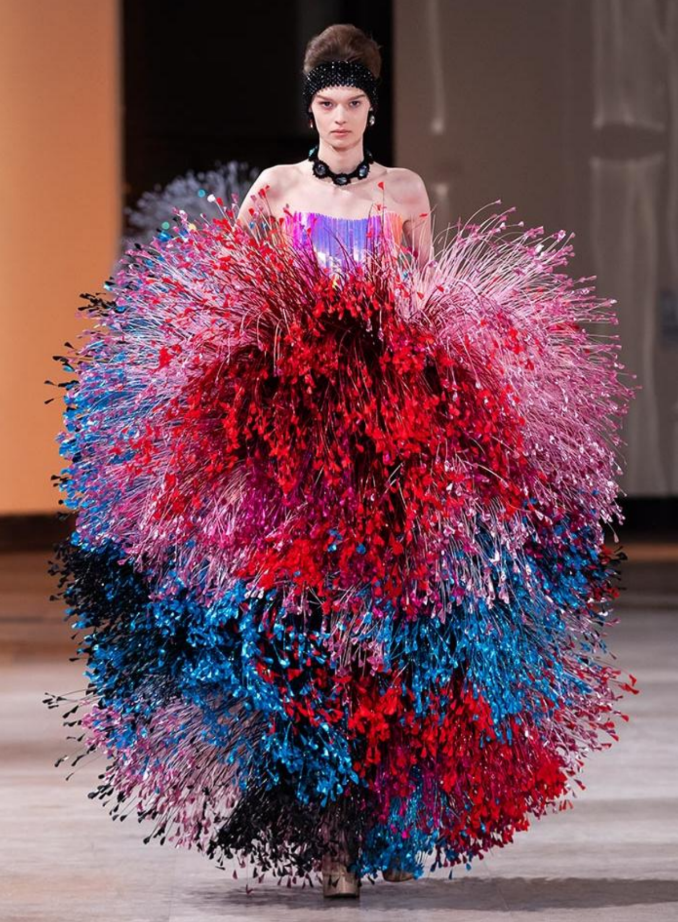
The revival of the word whimsy started around 2024, the year when I really started to
hear it everywhere. It became a core word to describe a feeling towards things that
didn’t quite fit neatly but brought a sense of joy in its sitting odd placement. In terms of
fashion, this became outfits that felt playful, chaotic, but somehow considered.
It moved quickly. Across Instagram, through comedy, styling, makeup, and even the way
people began curating their everyday lives. Whimsy became a description for something
harder to articulate, a way of dressing that didn’t need to explain itself.
According to Pinterest Predicts, “cultivating whimsy” reflects a growing desire to
romanticise the everyday, finding joy in small, often overlooked moments. But in
fashion, whimsy feels like more than just romanticisation. It feels like a soft response.
There’s a reason this aesthetic is surfacing now.
As fashion psychologist Dr Dion Terrelonge explains, “whimsical aesthetics tend to
resonate with people, particularly at times of uncertainty or global turmoil… It provides
a form of escapism from reality and beauty for the sake of beauty in the face of events
which might feel ugly.” Bows, frills, and ruffles serve as visual reminders that softness
still exists.
For a generation shaped by instability, pandemic lockdowns, climate anxiety, and the
constant noise of digital life, the pull towards something gentler makes sense. Dr
Dawnn Karen reinforces this, noting that whimsical aesthetics resonate because of “a
deep human need to create a world that is the complete opposite of what is happening
globally.” Whimsy then becomes a quiet form of resistance.
Part of whimsy’s appeal sits in something deeper, the growing language around the
inner child. As explored by Dazed, the focus on whimsy reflects a broader cultural shift
towards nurturing play, softness and emotional expression. It aligns with the idea of
“kidulting”, adults returning to objects and aesthetics tied to childhood. Seen in toy-like
proportions, padded textures, and bright, almost cartoonish detailing.

When online, leans towards sameness with algorithms that reward repetition, whimsy
disrupts that. It doesn’t fit neatly into a grid. It asks you to step slightly outside of it.
My own entry point into whimsy has always been through socks. Loud ones. See-
through fabrics layered with patterns. Neon colours. Multi-coloured pairs that clash
with everything else I’m wearing. Whether styled with heels, peeking out beneath a skirt,
or deliberately visible with cropped trousers, they’ve always felt like the most honest
part of my outfit.

There was a time when they felt out of place. When people questioned them, looked
twice, and didn’t quite understand the decision. That only made me love them more.
They became a small act of rebellion in my choice to dress differently.
Now, as whimsical styling becomes more accepted, those same choices don’t feel as
unusual. But instead of losing their meaning, it’s made me curious. If whimsy is
becoming shared, where does my version of it go next?
Maybe that’s the point. Whimsical dressing doesn’t give you a fixed identity. Instead, it
gives you space to experiment and try on different versions of yourself without needing
them to make perfect sense.
This is where whimsy quietly connects to sustainability. In a fashion system driven by
mass production and fast-moving trends, whimsy resists uniformity and leans into
individuality. Pre-loved shopping becomes a natural extension of that. Not just because
it’s sustainable, but because it offers something new fashion often can’t:
unpredictability! Pieces that feel slightly off. Garments that carry history. Items that can
be reworked, layered, or styled in ways that feel entirely your own.
As noted in Harper’s Bazaar, in an era dominated by mass-produced clothing, detail
carries emotional weight, reminding us that clothes can still feel like something made,
rather than simply consumed. Whimsy shifts the focus. Away from accumulation, and
towards imagination.
There’s a quiet defiance running through all of this. As Jane Dhall describes it, “whimsy
builds distance from the pressures of the present… It’s armour, if you will.”
But it’s a softer kind of armour. In a world that often feels fast, heavy, and overly defined,
choosing to dress with lightness becomes meaningful. Joy. Play. A little bit of
strangeness. Whimsy, at its core, is the decision to make space for that.