Rising Voices at the V&A Review: Contemporary Art from Asia and the Pacific
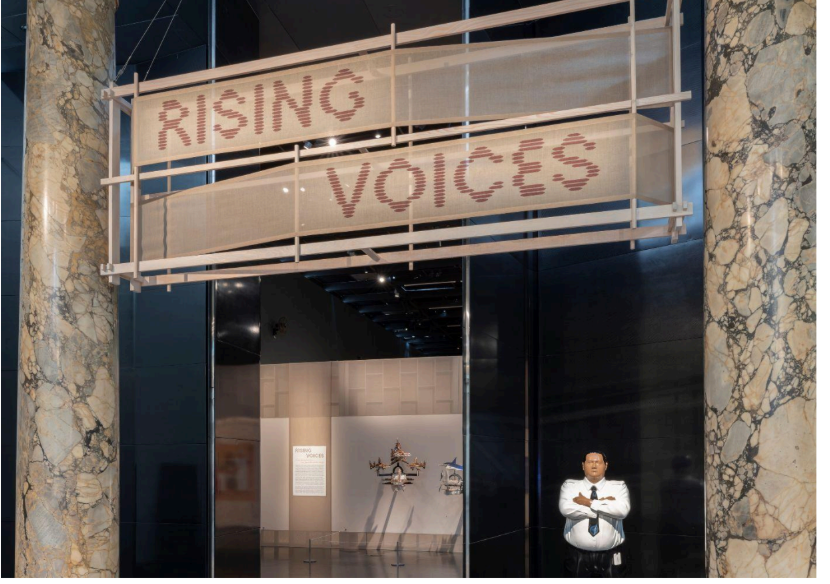
Rising Voices: Contemporary Art from Asia, Australia and the Pacific is a new exhibition at V&A in South Kensington, which takes the visitor on a rich journey through the artworks of 25 countries, incorporating multifarious traditional art forms, skilled craftsmanship, and large-scale contemporary installations. This compact exhibition is a first collaboration between the V&A and Queensland Art Gallery | Gallery of Modern Art (QAGOMA), and manages to distill 30 years of artwork into just three sections.
The exhibition has an ambitious geographical scope, introducing the viewer to artworks from diverse cultures as far apart as Iran and Hawaii, whilst also taking in Mongolia to the north and New Zealand in the south. The cohesive presentation of art forms from such disparate cultures is clearly no mean feat and required careful planning.
“Rising Voices is a result of a long time travelling and researching in the region and working with artists to identify the important stories they wanted to tell,” explains Tarun Nagesh, QAGOMA’s Curatorial Manager of Asian and Pacific Art.
Nagesh acknowledges the challenges of picking and choosing artworks intended to represent such a range of diverse cultures. “We focused on a few ideas that could resonate across the whole region, and drew attention to a few important artists that haven’t had the chance to be considered in a context like this,” he says.
The show puts First Nations perspectives to the forefront, highlighting artistic forms and techniques which are often excluded from European institutions.
“We were thinking about how to translate histories and regions that aren’t widely understood in the UK, while still retaining the impact these works would have if experienced in the Asia-Pacific itself,” says Daniel Slater, Director of Exhibitions at the V&A.
Rising Voices features over 70 works, moving swiftly between sculpture, weaving, painting,
photography, ceramics, and body adornment. Many of the exhibits have never previously been shown outside the Asia-Pacific region, and some of these art forms rarely feature in gallery displays.
The skills and techniques of traditional craftspeople are widely celebrated. The section “Enduring Knowledge” explores ancestral memory and foregrounds inventive approaches to working with Indigenous materials.
Jewellery lovers will be drawn to the necklaces by Lola Greeno, crafted from shimmering maireener and abalone shells.
Other striking jewellery pieces include iridescent breastplates by Sofia Tekela-Smith, who was born and bred in Aotearoa New Zealand. Large pearl shells are affixed to strands of black synthetic twine, alluding to the use of human hair as a material in older Polynesian jewellery pieces.
Here, the viewer is invited to reassess the fine line between ‘craft’ and ‘art’, as sculpted works of woven basketry transcend the functional to become works of great beauty.
Tongan baskets by Lesieli Tupou are woven from coconut husk fibre using the historic mosikaka technique, an intricate, intensely labour-intensive process once reserved for royalty. The practice had nearly disappeared before Tupou and her students began reviving it, creating works that speak not only to inherited tradition but to the active reconstruction of cultural knowledge.
“These pieces might historically have been presented in an anthropological context,” Slater explains. “We absolutely wanted to turn that on its head.”
Exquisite baskets by Shirley Macnamara weave together unexpected materials such as coiled spinifex, bones, and echidna quills. Her baskets are lined in red ochre and beautifully adorned with emu and galah feathers. Macnamara lives on a cattle station in far western Queensland, where she works with materials including wire and copper ore collected from an abandoned mine near her property.
Large-scale narrative paintings anchor one of the exhibition’s strongest sections, demonstrating the quality of artistry across the region and providing an artist’s insight into the political struggles of those countries.
There is still a war going on in Bougainville (1995) is a highlight. Illustrated in a bright, cartoonish style, the painting revisits the Bougainville conflict of the late 1980s and the blockade imposed by the Papua New Guinea Defence Force using Australian-supplied helicopters. This collaborative piece was created by four PNG artists, Brenda Fajardo, Elisabet Kauage, Mathias Kauage and John Siune.
Political themes are also explored in a collection of South Asian traditional miniature paintings.
Pakistani artist Saira Wasim uses the intimate form of Mughal miniature to parody political themes, while Pushpa Kumari and Nusra Latif Qureshi challenge conventions of South Asian miniature painting by placing their female subjects centre frame.
Iranian artists Maryam Ayeen and Abbas Shahsavar use vivid colours and striking patterns to draw the viewers into finely detailed interiors. “Fall in Dopamine” shows intimate, sharply observed scenes of a couple taking illicit recreational drugs, using humour to probe escape and autonomy within the confines of life in Iran.
The grand finale of the exhibition “Evolving Faith,” presents large-scale key works that shift the exhibition into an immersive, three-dimensional environment.
Reflection Model (Perfect Bliss) is a showstopper. This intricate sculpture by Japanese artisTakahiro Iwasaki, hovering at eye-level like a spacecraft, is suspended from the ceiling. The three-metre-long replica of the Phoenix Hall at Byōdō-in Temple in Kyoto is meticulously and faithfully rendered to the original structure.
Equally grand is Lotus Sound by Montien Boonma, an installation set against a curved wall, composed of hundreds of terracotta bells precariously stacked one atop another.
The work is inspired by the chiming bells of temple sanctuaries in Chiang Mai, which represent Buddhist symbols of wisdom and enlightenment.
Despite spanning a vast geography and an extraordinary range of artworks, the exhibition holds together remarkably well. There’s a real sense of cohesion shaped by shared threads of cultural knowledge, which creates a convincing dialogue between the pieces.
The sheer variety of artworks will keep everyone engaged. Rising Voices is an intimate entry
point into the broader scope of art in the Asia Pacific region. This viewer was left intrigued, and wanting more.
Rising Voices at the V&A opens May 16, 2026, and runs through January 10, 2027.